

If you just learn these six verbs, you can say anything in Italian! Think you need to know all Italian verb conjugations to speak fluently? That’s a sure way to feel stuck. With hundreds of verbs, plus all those tricky irregular ones, it’s easy to feel overwhelmed. And where do you even start? Transitive, intransitive, reflexive, pronominal, impersonal… there are so many types!
But here’s the thing: you don’t need to learn them all to start speaking Italian. Seriously! If you just focus on six key Italian verbs, you’ll be able to express almost anything without drowning in conjugation charts. These magic verbs include the four modal ones (volere, potere, sapere, dovere), along with essere and avere, the backbone of Italian grammar.
Just by mastering these verbs first, forming sentences in Italian will become a lot easier. Allowing you to speak Italian faster! Plus, they’re super common, so you’ll hear them constantly — in movies, on the street, at the store — meaning tons of chances to practice,
In this guide, I’ll show you exactly how these six verbs can help you build thousands of sentences, boosting your confidence and help you speak Italian sooner than you’d expect. Once you’ve mastered these 6 verbs, you can join the Intrepid Italian 30-Day Verbs Challenge to learn more verbs to an expand your vocabulary.
By the way, want to improve your Italian quickly and having fun doing it? I thought so! If you’re a beginner, I recommend Intrepid Italian, my comprehensive self-paced programme that teaches you through the power of my unique 80/20 method. The course covers everything you need to know as a beginner in Italian. Join now for lifetime access and my 30-Day “Celebrate with a Spritz” money-back guarantee by clicking here.
Or if you’re already at the intermediate level, why not enrol in Intrepid Italian for Advanced Beginners (A2) or Intrepid Italian for Intermediates (B1), my more advanced programmes that helps you master the trickiest aspects of Italian grammar while as you edge closer to fluency in Italian.
Watch this lesson on my YouTube channel
How to use Italian modal verbs

Modal verbs are a special group of verbs that don’t just tell us what happens, but how it happens. Italians also call them verbi servili (from servire – to serve, to be needed), because they “serve” another verb by adding meaning to it, clarifying the manner in which the action is carried out. Is it an intention? Does it have to do with an ability? Or is it perhaps an obligation?
There are four main modal verbs in Italian:
- Volere (to want)
- Potere (to be able to/can)
- Sapere (to know how to)
- Dovere (to have to/must)
They’re all irregular, which means you’ll need to memorise each one. But once you do, you’ll be able to create all sorts of sentences on your own. How? With this secret formula:
Conjugated modal verb + infinitive verb
That’s it. No need to memorise long lists of conjugations. With just these four verbs and this simple structure, you’ll be able to express pretty much anything you want in Italian! Don’t believe it? Take a look at this example:
Instead of saying:
- Vieni a teatro con noi domani?—Are you coming to the theatre with us tomorrow?
You could say:
- Vuoi venire a teatro con noi domani?—Do you want to come to the theatre with us tomorrow?)
See? No need to remember the second person singular of venire (to come). You just conjugate the modal verb volere (want) and add the infinitive!
So, let’s break them down one by one, explore how they are used, and see how they conjugate in key tenses.
1. Volere (want, want to)
| Key conjugations of “volere” in Italian | |||||
|---|---|---|---|---|---|
| Subject | Present | Imperfect | Simple Future | Passato prossimo | Present conditional |
| Io (I) | voglio | volevo | vorrò | ho voluto | vorrei |
| I want | I was wanting | I will want | I wanted | I would want | |
| Tu (You) | vuoi | volevi | vorrai | hai voluto | vorresti |
| You want | You were wanting | You will want | You wanted | You would want | |
| Lui/Lei (He/She) | vuole | voleva | vorrà | ha voluto | vorrebbe |
| He/She wants | He/She was wanting | He/She will wanting | He/She wanted | He/She would want | |
| Noi (We) | vogliamo | volevamo | vorremo | abbiamo voluto | vorremmo |
| We want | We were wanting | We will want | We wanted | We would want | |
| Voi (You) | volete | volevate | vorrete | avete voluto | vorreste |
| You want | You were wanting | You will want | You wanted | You would want | |
| Loro (They) | vogliono | volevano | vorranno | hanno voluto | vorrebbero |
| They want | They were wanting | They will want | They wanted | They would want | |
With volere, you can express desires, requests, and future intentions easily. It can be used on its own followed by a noun or with another verb in the infinitive form, which makes it a handy shortcut! Here’s to use it in everyday conversations:
To say what you want, just like “I want” in English:
| Standard phrase | Phrase with modal verb |
|---|---|
| Comprerei una gonna rossa. – I’d like to buy a red skirt. | Vorrei comprare una gonna rossa. – I’d like to buy a red skirt. |
| Domani mangiamo una bella carbonara. – Tomorrow I’m eating a nice carbonara. | Domani vogliamo mangiare una bella carbonara. – Tomorrow I want to eat a nice carbonara. |
Attenzione: In Italian, using volere in the present tense to ask for something can sound too direct and impolite. Instead, Italians soften it with the conditional:
- Vorrei mangiare una margherita. – I’d like a margherita pizza.
To talk about a desire or a future goal:
| Standard phrase | Phrase with modal verb |
|---|---|
| Ci piacerebbe comprare una casa in montagna. – We would like to buy in the mountains. | Vorremmo comprare una casa in montagna. – We would like to buy a house in the mountains. |
| Sognavo di andare in Giappone. – I would like to go to Japan. | Volevo andare in Giappone. – I would like to go to Japan. |
To offer something or ask what others want:
| Standard phrase | Phrase with modal verb |
|---|---|
| Assaggiate il Limoncello della casa? – Would you like to try the house Limoncello? | Volete assaggiare il Limoncello della casa. – Would you like to try the house Limoncello. |
| Mangi qualcosa prima di uscire? – Would you like to eat something before going out? | Vuoi mangiare qualcosa prima di uscire? – Would you like to eat something before going out? |
To make invitations:
| Standard phrase | Phrase with modal verb |
|---|---|
| Partecipi alla raccolta fondi? – Would you like to participate in the fundraising? | Vuoi partecipare alla raccolta fondi? – Would you like to participate in the fundraising? |
| Signora Gianna, viene con noi a teatro? – Ms. Gianna, would you like to come to the theatre with us? | Signora Gianna, vuole venire con noi a teatro? – Ms. Gianna, would you like to come to the theatre with us? |
Here’s a little trick to sound even more natural: when volere is in the infinitive and followed by another verb, it often gets shortened to voler. This helps everything flow more smoothly:
- Simone continua a non voler mangiare. – Simone insists on not wanting to eat.

2. Potere (can, be able to)
| Key conjugations of “potere” in Italian | |||||
|---|---|---|---|---|---|
| Subject | Present | Imperfect | Simple Future | Passato prossimo | Present conditional |
| Io (I) | posso | potevo | potrò | ho potuto | potrei |
| I can | I was able to | I will be able to | I could | I would be able to | |
| Tu (You) | puoi | potevi | potrei | hai potuto | potresti |
| You can | You were able to | You will be able to | You could | You would be able to | |
| Lui/Lei (He/She) | può | poteva | potrà | ha potuto | potrebbe |
| He/She can | He/She was able to | He/She will be able to | He/She could | He/She would be able to | |
| Noi (We) | possiamo | potevamo | potremo | abbiamo potuto | potremmo |
| We can | We were able to | We will be able to | We could | We would be able to | |
| Voi (You) | potete | potevate | potrete | avete potuto | potreste |
| You can | You were able to | You will be able to | You could | You would be able to | |
| Loro (They) | possono | potevano | potranno | hanno potuto | potrebbero |
| They can | They were able to | They will be able to | They could | They would be able to | |
Potere is the verb you need when talking about what’s possible, allowed, or what can happen. Unlike the English “can,” which often refers to personal ability, potere is more about what is feasible based on external factors, like permission or circumstances. Using the formula potere + infinitive is the simplest way to express these ideas.
Here are the most common uses of potere in Italian:
To talk about what’s possible or likely to happen:
| Standard phrase | Phrase with modal verb |
|---|---|
| Aiuto anch’io! – I’ll help, too! | Posso aiutare anch’io! – I can help, too! |
| Vanno ancora in giro nonostante la denuncia? – Are they still roaming free despite the charge? | Possono andare ancora in giro nonostante la denuncia? – Can they still roam free despite the charge? |
Attenzione: When talking about knowing how to do something (like sports or other activities), Italians use sapere instead of potere. Think of it as “I know how to…”
- So parlare in cinese, ma non so scrivere molto bene –I know how to speak Chinese, but I don’t know how to write very well.
To ask for permission or politely request something:
- Possiamo venire da te più tardi? – Can we come over later?
- Posso fare una telefonata?–Can I make a phone call?
| Standard phrase | Phrase with modal verb |
|---|---|
| Ci sediamo qui? – Can we sit here? | Possiamo sederci qui? – Can we sit here? |
| Ordinate voi le pizze? – Will you order the pizzas? | Potete ordinare voi le pizze? – Can you order the pizzas? |
To say that something is not possible, or to express a prohibition:
| Standard phrase | Phrase with modal verb |
|---|---|
| Non parcheggiate qui, è vietato. – Don’t park here, it’s prohibited. | Non potete parcheggiare, è vietato. – You cannot park here, it’s prohibited. |
| Non vengo in montagna questo fine settimana, devo studiare. – I’m not coming to the mountains this weekend, I have to study. | Non posso venire in montagna questo fine settimana, devo studiare. – I can’t come to the mountains this weekend, I have to study. |

3. Sapere (know how to)
| Key conjugations of “sapere” in Italian | |||||
|---|---|---|---|---|---|
| Subject | Present | Imperfect | Simple Future | Passato prossimo | Present conditional |
| Io (I) | so | sapevo | saprò | ho saputo | saprei |
| I know | I knew | I will know | I found out | I would know | |
| Tu (You) | sai | sapevi | saprai | hai saputo | sapresti |
| You know | You knew | You will know | You found out | You would know | |
| Lui/Lei (He/She) | sa | sapeva | saprà | ha saputo | saprebbe |
| He/She knows | He/She knew | He/She will know | He/She found out | He/She would know | |
| Noi (We) | sappiamo | sapevamo | sapremo | abbiamo saputo | sapremmo |
| We know | We knew | We will know | We found out | We would know | |
| Voi (You) | sapete | sapevate | saprete | avete saputo | sapreste |
| You know | You knew | You will know | You found out | You would know | |
| Loro (They) | sanno | sapevano | sapranno | hanno saputo | saprebbero |
| They know | They knew | They will know | They found out | They would know | |
Perhaps you already know that sapere means “to know,” but when used as a modal verb, it actually means “to know how to do something.” Unlike potere, where the ability to do something depends on external factors, sapere is about things you can do because you’ve learned them or you have skills to do them.
Another interesting characteristic of sapere as a modal verb is its behaviour in the passato prossimo tense. While the modal verbs volere, potere and dovere retain their meaning in this tense, implying that the action was completed, sapere undergoes a complete shift in meaning: it no longer refers to a state of knowing (knowing how to do something) but instead indicates a moment of discovery or acquiring knowledge (“found out”).
Additionally, as a modal verb, sapere followed by the infinitive helps you avoid the conjugations of verbs like imparare (to learn), essere in grado di (to be able to), or essere capace di (to be able to). Here are some examples:
| Standard phrase | Phrase with modal verb |
|---|---|
| Anche voi suonate il pianoforte? – Do you also know how to play the piano? | Anche voi sapete suonare il pianoforte? – Do you also know how to play the piano? |
| Giovanni parlava molto bene il tedesco al liceo. – Giovanni spoke German very well in high school. | Giovanni sapeva parlare molto bene il tedesco al liceo. – Giovanni knew how to speak German very well in high school. |
| Custodiremo il tuo segreto. – We will keep your secret. | Sapremo custodire il segreto. – We will be able to keep the secret. |
| Scusa, che ore sono ? – Excuse me, what time is it? | Scusa, mi sai dire l’ora? – Excuse me, can you tell me the time? |

4. Dovere (must, have to)
| Key conjugations of Dovere in Italian | |||||
|---|---|---|---|---|---|
| Subject | Present | Imperfect | Simple Future | Passato prossimo | Present conditional |
| Io (I) | devo | dovevo | dovrò | ho dovuto | dovrei |
| I have to | I was having to | I will have to | I had to | I would have to | |
| Tu (You) | devi | dovevi | dovrai | hai dovuto | dovresti |
| You have to | You were having to | You will have to | You had to | You would have to | |
| Lui/Lei (He/She) | deve | doveva | dovrà | ha dovuto | dovrebbe |
| He/She has to | He/She was having to | He/She will have to | He/She had to | He/She would have to | |
| Noi (We) | dobbiamo | dovevamo | dovremo | abbiamo dovuto | dovremmo |
| We have to | We were having to | We will have to | We had to | We would have to | |
| Voi (You) | dovete | dovevate | dovrete | avete dovuto | dovreste |
| You have to | You were having to | You will have to | You had to | You would have to | |
| Loro (They) | devono | dovevano | dovranno | hanno dovuto | dovrebbero |
| They have to | They were having to | They will have to | They had to | They would have to | |
The verb dovere is used to express obligations, duties, or things that must be done. It also helps give advice, make logical assumptions, and even talk about payments and debts.
How to use dovere in everyday Italian:
To talk about things you must do or have to do:
| Standard phrase | Phrase with modal verb |
|---|---|
| Andrò in ufficio anche sabato. – I have to go to the office even on Saturday. | Dovrò andare in ufficio anche sabato. – I have to go to the office even on Saturday. |
| Partite presto domani? – Are you leaving early tomorrow? | Dovete partire presto domani? – Are you leaving early tomorrow? |
To give advice or suggest what should be done:
| Standard phrase | Phrase with modal verb |
|---|---|
| Chiama tua madre, altrimenti si preoccupa. – You should call your mom, or she’ll worry. | Devi chiamare tua madre, altrimenti si preoccupa. – You should call your mom, or she’ll worry. |
| Leggete questo libro, è incredibile! – Read this book, it’s incredible! | Dovete leggere questo libro, è incredibile! – You must read this book, it’s incredible! |
To express what was supposed to happen but didn’t (using the imperfect tense):
| Standard phrase | Phrase with modal verb |
|---|---|
| Eravamo d’accordo di vederci qui un’ora fa. – We agreed to meet here an hour ago. | Dovevamo vederci qui un’ora fa. – We agreed to meet here an hour ago. |
| Avevano deciso di andare al concerto insieme. – They decided to go to the concert together. | Dovevano andare al concerto insieme. – They decided to go to the concert together. |
To guess or assume something based on what we know or what seems logical:
| Standard phrase | Phrase with modal verb |
|---|---|
| Immagino costi parecchio! – It must cost a lot! | Deve costare parecchio! – It must cost a lot! |
| Presumo siano buoni questi pasticcini, sono fatti in casa. – I assume these pastries are good, they are homemade. | Devono essere buoni quei pasticcini, sono fatti in casa! – These pastries must be good, they are homemade. |

Auxiliary verbs with Italian modal verbs
In compound tenses, the auxiliary verb that you use with modal verbs depends on the verb that comes after them.
If the modal verb is followed by a verb that normally takes essere (to be), then the whole sentence uses essere as the auxiliary. And with the auxiliary essere, you also need to adjust the past participle according to the gender and number of the subject:
- Lucia non è voluta andare a scuola oggi. – Lucia didn’t want to go to school today.
- Sergio è dovuto andare via subito. – Sergio had to leave immediately.
If the modal verb is followed by a verb that normally takes avere (to have), then the sentence also uses avere as the auxiliary. In this case, the past participle does not change to match the gender or number of the subject:
- Ho voluto provare. – I wanted to try.
- Elena non ha saputo recitare la poesia. – Elena wasn’t able to recite the poem.
If the modal verbs is not followed by another verb, but directly takes a noun (direct object), then it always takes avere as the auxiliary:
- Abbiamo voluto fortemente questo evento. – We strongly wanted this event.
Finally, with reflexive verbs there are two possibilities:
- If the reflexive pronoun comes before the modal verb, we use the auxiliary essere, as in Oggi ci siamo dovuti svegliare molto presto. – Today we had to wake up very early.
- If the reflexive pronoun is attached to the infinitive, we use avere, as in Abbiamo dovuto svegliarci presto oggi. – We had to wake up early today.
Position of pronouns with Italian modal verbs
When using pronouns with modal verbs in Italian, there are two ways to position them:
You can place the pronoun right before the modal verb:
- A: Hai visto le nuove scarpe di Chiara? – Did you see Chiara’s new shoes?
B: Sì, le voglio comprare anch’io! – Yes, I want to buy them too!
Or, you can attach the pronoun directly to the infinitive verb that follows the modal verb:
- A: Giacomo ti sta cercando. – Giacomo is looking for you.
B: Vero, dovevo chiamarlo! – Right, I should have called him!
Attenzione! You cannot place the pronoun between the modal verb and the infinitive. Just choose one of the two correct placements above, and you won’t make mistakes!
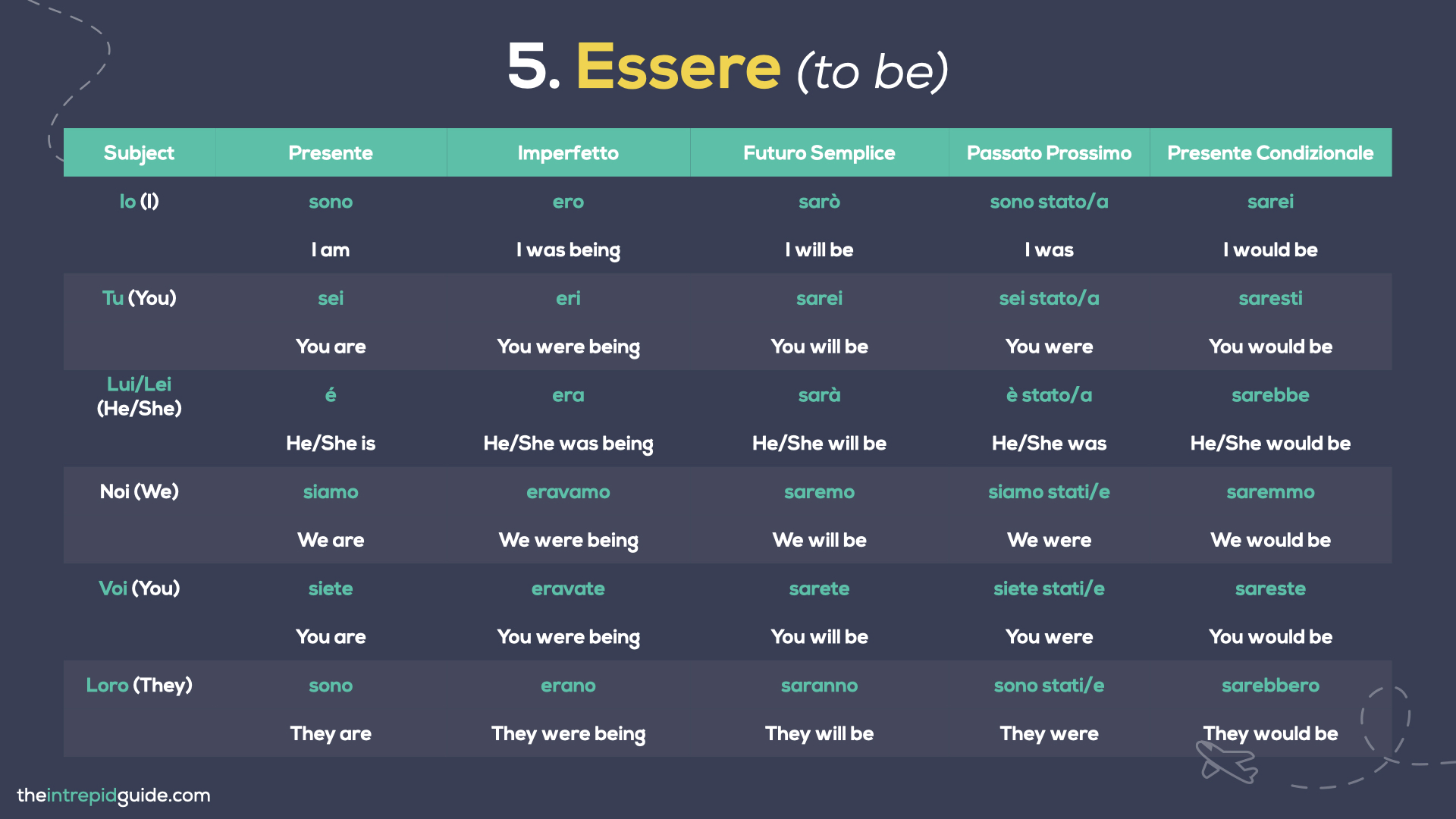
5. Essere (to be)
Essere (to be) is another essential verb in Italian—it’s practically everywhere! You can use it virtually in every sentence, whether you’re talking about emotions, qualities, locations, and it’s essential for building the compound tenses of many verbs. And it’s irregular too:
| Key conjugations of “essere” in Italian | |||||
|---|---|---|---|---|---|
| Subject | Present | Imperfect | Simple Future | Passato prossimo | Present conditional |
| Io (I) | sono | ero | sarò | sono stato/a | sarei |
| I am | I was being | I will be | I was | I would be | |
| Tu (You) | sei | eri | sarei | sei stato/a | saresti |
| You are | You were being | You will be | You were | You would be | |
| Lui/Lei (He/She) | é | era | sarà | è stato/a | sarebbe |
| He/She is | He/She was being | He/She will be | He/She was | He/She would be | |
| Noi (We) | siamo | eravamo | saremo | siamo stati/e | saremmo |
| We are | We were being | We will be | We were | We would be | |
| Voi (You) | siete | eravate | sarete | siete stati/e | sareste |
| You are | You were being | You will be | You were | You would be | |
| Loro (They) | sono | erano | saranno | sono stati/e | sarebbero |
| They are | They were being | They will be | They were | They would be | |
Main uses of essere in Italian
To introduce yourself or others, talking about age, job, nationality, or other personal details:
- Io sono Michele, sono Australiana. – I’m Michele, I’m Australian. (Fun fact: This one’s about me, my name is Michele 9 after my nonno – I have a masculine name, but I’m female hence Australiana)
- Suo fratello è un famoso medico. – Her brother is a famous doctor.
To describe objects, people, or places:
- Queste scarpe sono bellissime! – These shoes are beautiful!
- Vostro zio è simpaticissimo! – Your uncle is super nice!
To express how you feel or describing someone’s emotional state:
- Sono felice di essere qui. – I’m happy to be here.
- Stefano è molto arrabbiato. – Stefano is ready angry.
Essere can sometimes replace the verbs stare and trovarsi when you’re talking about locations or situations:
- Siete ancora a casa? – Are you still at home?
- Mio fratello è ancora a Londra. – My brother is still in London.
Finally, essere plays a key role as an auxiliary verb in compound tenses, especially with intransitive verbs, reflexive verbs, impersonal verbs, and even essere itself:
- Sono arrivato tardi. – I arrived late.
- Mi sono svegliato presto. – I woke up early.
6. Avere (to have)
Avere is another extremely useful verb for constructing sentences in Italian. You’ll use it to talk about things you own, your age, and even how you’re feeling. And, along with essere, it’s key to forming the compound tenses of many verbs. Once again, you’ll need to memorise some irregular forms in order to master it:
| Key conjugations of “avere” in Italian | |||||
|---|---|---|---|---|---|
| Subject | Present | Imperfect | Simple Future | Passato prossimo | Present conditional |
| Io (I) | ho | avevo | avrò | ho avuto | avrei |
| I have | I was having | I will have | I had | I would have | |
| Tu (You) | hai | avevi | avrai | hai avuto | avresti |
| You have | You were having | You will have | You had | You would have | |
| Lui/Lei (He/She) | ha | aveva | avrà | ha avuto | avrebbe |
| He/She has | He/She was having | He/She will have | He/She had | He/She would have | |
| Noi (We) | abbiamo | avevamo | avremo | abbiamo avuto | avremmo |
| We have | We were having | We will have | We had | We would have | |
| Voi (You) | avete | avevate | avrete | avete avuto | avreste |
| You have | You were having | You will have | You had | You would have | |
| Loro (They) | hanno | avevano | avranno | hanno avuto | avrebbero |
| They have | They were having | They will have | They had | They would have | |
Main uses of avere in Italian:
To talk about possessions:
- Claudio ha una bellissima auto. – Claudio owns a beautiful car.
- Avete una penna rossa? – Do you have a red pen?
To talk about age:
- Quanti anni avete? – How old are you?
- Mio padre ha 70 anni. – My dad is 70 years old.
To describe physical characteristics:
- Il mio ragazzo ha gli occhi verdi. – My boyfriend has green eyes.
- Sua sorella ha i capelli castani. – His sister has brown hair.
To express physical needs or certain feelings:
- Abbiamo fame! – We’re hungry!
- Ho paura. – I’m afraid.
Finally, avere serves as the auxiliary verb for transitive verbs and for avere itself:
- Non hanno avuto tempo. – They didn’t have time.
- Hai mangiato le banane? – Did you eat the bananas?

If you found this guide useful, then you’ll love Intrepid Italian, my series of online self-paced video courses that break down everything you need to know about Italian using my 80/20 method. Visit IntrepidItalian.com for more details.
 Are you a beginner or an intermediate Italian learner? Got a trip coming up or want to communicate with your Italian partner or relatives in Italian? Learn Italian with my unique 80/20 method
Registrations are now open to join Intrepid Italian, my new series of online video courses that use my unique 80/20 method. You’ll go from a shy, confused beginner to a proficient and confident intermediate speaker, with me as your trusty guide.
You’ll finally be able to connect with your Italian partner, speak to your relatives and enjoy authentic travel experiences in Italy that you’ve always dreamed of, and so much more.
As a native English speaker who learned Italian as an adult, I know what it’s like to feel hopeless and lack the confidence to speak. I know what it’s like to start from scratch and to even go back to absolute basics and learn what a verb is!
Intrepid Italian was created with YOU in mind. I use my working knowledge of the English language to help you get into the ‘Italian mindset’ so you can avoid the common pitfalls and errors English speakers make – because I made them once too! I break everything down in such a way that it ‘clicks’ and just makes sense.
No matter what your level is, there is an Intrepid Italian course for you, including:
- 🇮🇹 Intrepid Italian for Beginners (A1)
- 🇮🇹 Intrepid Italian for Advanced Beginners (A2)
- 🇮🇹 Intrepid Italian for Intermediates (B1)
You can join 1, 2, or all 3 courses, it’s entirely up to you. The best part is that you have lifetime access so you learn anytime, anywhere and on any device.
As your guide, I walk you through each lesson, step-by-step, using my unique 80/20 method. My approach is different from traditional methods because I teach you the most important 20% of the language right from the beginning so you can start to speak straight away.
Each course includes video lessons, audio exercises, downloadable worksheets, bonus guides, a private support community, and lifetime access all designed to streamline your learning while having fun.
It even comes with my famous “Celebrate with a Spritz Guarantee”. After 30 days of using Intrepid Italian, if you don’t want to celebrate your new-found Italian skills with an Aperol Spritz, you don’t have to pay a penny! Cheers! 🥂
Join Intrepid Italian here and start learning today!
Ci vediamo lì! (See you there!)
Learning Italian? Check out these Italian language guides
- Italian for Beginners | How to Learn Italian in 3 Simple Steps
- TOP 100 Most Common Italian Words (Plus PDF Cheat-Sheet & Quiz)
- Italian Prepositions:The Only Guide You’ll Ever Need (PLUS Chart)
- 17 Weird Italian Superstitions Italians ACTUALLY Live By
- 17 Must-Know Italian Hand Gestures: The Ultimate Guide
- 10 Ways Natives REALLY Say ‘You’re Welcome’ in Italian
- How to say ‘Please’ in Italian in 9 Ways Like a Native
- 41 Italian Greetings: How to Say ‘Hello’ in Italian Like a Local
- 125 Most Common Italian Phrases for Travel You’ll Ever Need [PLUS Printable]
- 8 DEADLY mistakes in Italian (& How to Avoid Them)
- How to Conjugate Italian Verbs in 3 Simple Steps [Italian for Beginners]
- Is Italian Hard to Learn? 7 Common Mistakes & How to Avoid Them
- Master Days of the Week in Italian (7 Simple Memory Hacks)
- Italian Numbers: How to Count in Italian From 0 to 1 Billion (Plus PDF Download)
- How to Order Food & Drinks in Italian [Italian for Beginners]
- 15 Italian Words You Should NEVER Mispronounce [& How Not To]
- 11 Effective Hacks That’ll Help You Learn Italian So Much Faster
- Top 14 Italian Words You Should NEVER Say [& What to Use Instead]
- 20 Hilarious Everyday Italian Expressions You Should Use
- Romanesco: 25 Cool Roman Dialect Words You Should Use in Rome
- 10 Reasons Why Learning Italian Will Change Your Life
- 10 Italian Expressions Italians Love Saying
- 10 Italian Phrases That Will Instantly Make You Sound more Italian
- Funny Italian Sayings: 26 Food-Related Insults You Won’t Forget
- 15 Romantic Italian Films That’ll Make You Love Italy Even More
- How to Master Common Italian Phrases for Travel (Like a Local!)
Like it? Pin it for later!

Over to you!
Did you enjoy this lesson? Do you have a question? Let me know using the comments section below or join me on social media @intrepidguide or @intrepiditalian to start a conversation.
Thanks for reading and I hope you enjoyed this post.
Like what you see? Subscribe using the form below to have all of my posts delivered directly to your email.
